Back to Blog
Pronunciation
Why you can understand English - But Still Struggle to speak Clearly
Many learners reach a point where comprehension feels easy, but speaking still feels blocked. This article explains why that happens — and how targeted pronunciation training helps break the barrier.
Jan 5, 2026
·
6 min read
Pronunciation
Confidence
Table of Contents
The Comprehension / Production Gap
Why English Is Tricky to Speak
The Limits of “Just Practice”
Focused Pronunciation Training
Key Takeaways
Related Articles

Speech Science
Minimal Pairs: The Smallest Change That Makes the Biggest Difference
Jan 5, 2026
·
6 min read
Read

Pronunciation
Why Some Sounds Feel “Invisible” to Your Ear
Dec 28, 2025
·
5 min read
Read

Accents
What Is an Accent — And Why You Don’t Need to “Lose” Yours
Jan 10, 2026
·
5 min read
Read

You understand English well.
You watch series without subtitles. You follow the news easily. Even fast conversations usually make sense.
But when it’s your turn to speak, it suddenly feels much harder.
Words don’t come out the way you expect. Your mouth hesitates.
Your confidence drops — even though you know what you want to say.
This is one of the most common experiences among advanced English learners.
The Comprehension / Production Gap
Nearly every second-language learner encounters this problem at some point.
You understand more than you can say.
Even when you know the right words, your mouth seems to struggle.
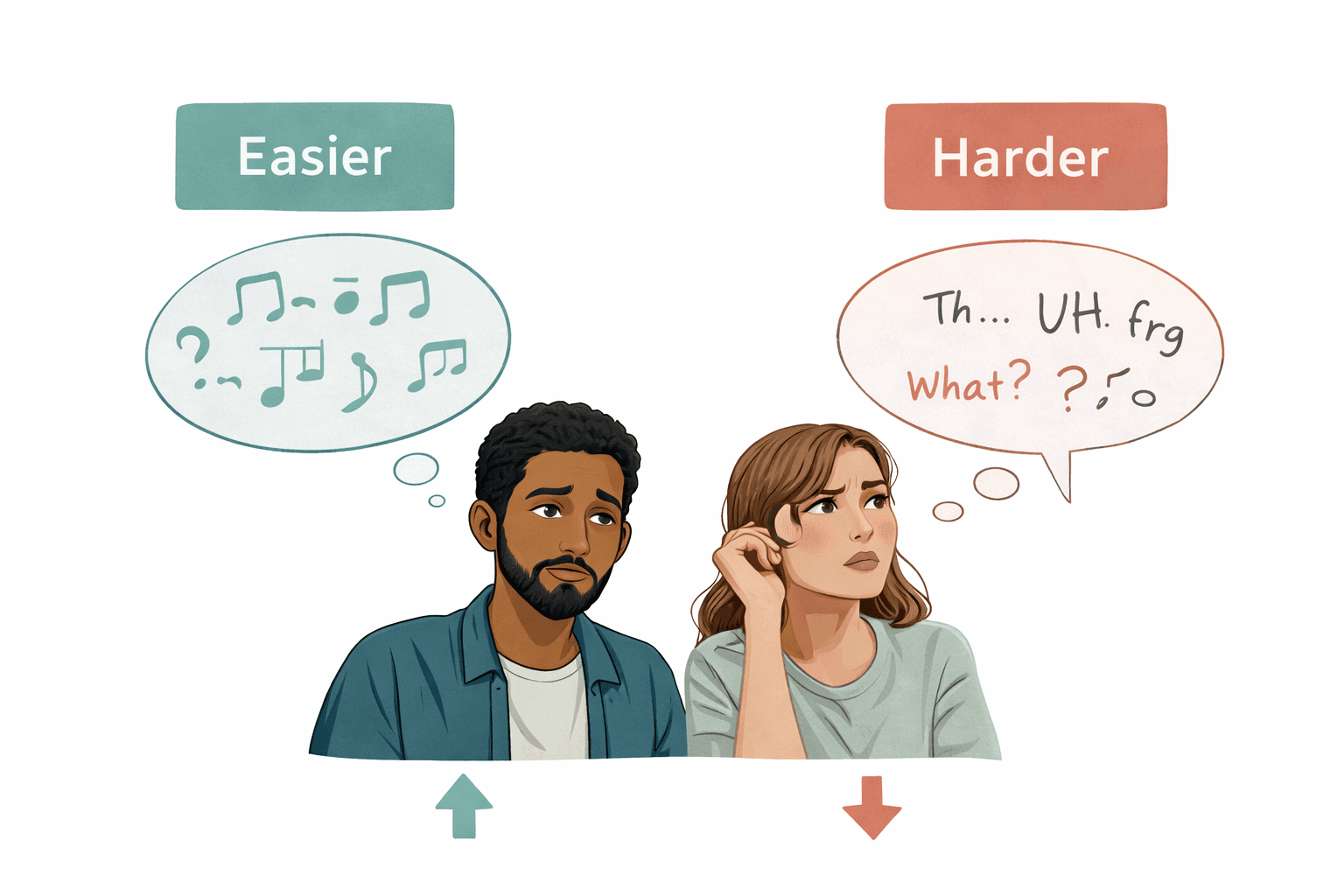
This phenomenon is known as the comprehension / production gap.
Understanding a language and producing it rely on different systems in the brain.
Listening is largely passive. Speaking is active, physical, and time-sensitive.
Why English Is Tricky to Speak
English pronunciation has several characteristics that make speaking difficult:
Sounds that don’t exist in your native language
Small sound differences that change meaning
Stress and rhythm patterns that affect clarity
If your brain hasn’t learned to notice these differences, your mouth can’t reliably produce them.
Focused Pronunciation Training
Effective pronunciation training works differently.
It focuses on:
training your ear before your voice
isolating specific sound contrasts
short, repeated sessions instead of long interruptions
This kind of training helps your brain create new sound categories — making clear speech feel more natural over time.
Key Takeaways
Understanding and speaking are different skills
Difficulty speaking doesn’t mean your English is “bad”
Pronunciation issues are often perceptual, not motivational
Focused training can significantly reduce the gap
Clear speech is not about sounding perfect.
It’s about being understood — confidently and consistently.
Shape your accent — not just your feed
Reading helps you understand.
Practice helps you change how you sound.
Start practicing

Download the app
Download on the
App Store
Get it on
Google Play
Back to Blog
Pronunciation
Why you can understand English - But Still Struggle to speak Clearly
Many learners reach a point where comprehension feels easy, but speaking still feels blocked. This article explains why that happens — and how targeted pronunciation training helps break the barrier.
Jan 5, 2026
·
6 min read
Pronunciation
Confidence
Table of Contents
The Comprehension / Production Gap
Why English Is Tricky to Speak
The Limits of “Just Practice”
Focused Pronunciation Training
Key Takeaways
Related Articles

Speech Science
Minimal Pairs: The Smallest Change That Makes the Biggest Difference
Jan 5, 2026
·
6 min read
Read
Pronunciation
Why Some Sounds Feel “Invisible” to Your Ear
Dec 28, 2025
·
5 min read
Read

Accents
What Is an Accent — And Why You Don’t Need to “Lose” Yours
Jan 10, 2026
·
5 min read
Read
You understand English well.
You watch series without subtitles. You follow the news easily. Even fast conversations usually make sense.
But when it’s your turn to speak, it suddenly feels much harder.
Words don’t come out the way you expect. Your mouth hesitates.
Your confidence drops — even though you know what you want to say.
This is one of the most common experiences among advanced English learners.
The Comprehension / Production Gap
Nearly every second-language learner encounters this problem at some point.
You understand more than you can say.
Even when you know the right words, your mouth seems to struggle.
This phenomenon is known as the comprehension / production gap.
Understanding a language and producing it rely on different systems in the brain.
Listening is largely passive. Speaking is active, physical, and time-sensitive.
Why English Is Tricky to Speak
English pronunciation has several characteristics that make speaking difficult:
Sounds that don’t exist in your native language
Small sound differences that change meaning
Stress and rhythm patterns that affect clarity
If your brain hasn’t learned to notice these differences, your mouth can’t reliably produce them.
Focused Pronunciation Training
Effective pronunciation training works differently.
It focuses on:
training your ear before your voice
isolating specific sound contrasts
short, repeated sessions instead of long interruptions
This kind of training helps your brain create new sound categories — making clear speech feel more natural over time.
Key Takeaways
Understanding and speaking are different skills
Difficulty speaking doesn’t mean your English is “bad”
Pronunciation issues are often perceptual, not motivational
Focused training can significantly reduce the gap
Clear speech is not about sounding perfect.
It’s about being understood — confidently and consistently.
Shape your accent — not just your feed
Reading helps you understand.
Practice helps you change how you sound.
Start practicing
Download the app
Download on the
App Store
Get it on
Google Play
Back to Blog
Pronunciation
Why you can understand English - But Still Struggle to speak Clearly
Many learners reach a point where comprehension feels easy, but speaking still feels blocked. This article explains why that happens — and how targeted pronunciation training helps break the barrier.
Jan 5, 2026 · 6 min read
Pronunciation
Confidence
You understand English well.
You watch series without subtitles. You follow the news easily. Even fast conversations usually make sense.
But when it’s your turn to speak, it suddenly feels much harder.
Words don’t come out the way you expect. Your mouth hesitates.
Your confidence drops — even though you know what you want to say.
This is one of the most common experiences among advanced English learners.
The Comprehension / Production Gap
Nearly every second-language learner encounters this problem at some point.
You understand more than you can say.
Even when you know the right words, your mouth seems to struggle.
This phenomenon is known as the comprehension / production gap.
Understanding a language and producing it rely on different systems in the brain.
Listening is largely passive. Speaking is active, physical, and time-sensitive.
Why English Is Tricky to Speak
English pronunciation has several characteristics that make speaking difficult:
Sounds that don’t exist in your native language
Small sound differences that change meaning
Stress and rhythm patterns that affect clarity
If your brain hasn’t learned to notice these differences, your mouth can’t reliably produce them.
Focused Pronunciation Training
Effective pronunciation training works differently.
It focuses on:
training your ear before your voice
isolating specific sound contrasts
short, repeated sessions instead of long interruptions
This kind of training helps your brain create new sound categories — making clear speech feel more natural over time.
Key Takeaways
Understanding and speaking are different skills
Difficulty speaking doesn’t mean your English is “bad”
Pronunciation issues are often perceptual, not motivational
Focused training can significantly reduce the gap
Clear speech is not about sounding perfect.
It’s about being understood — confidently and consistently.
Table of Contents
The Comprehension / Production Gap
Why English Is Tricky to Speak
The Limits of “Just Practice”
Focused Pronunciation Training
Key Takeaways
Related Articles

Speech Science
Minimal Pairs: The Smallest Change That Makes the Biggest Difference
Jan 5, 2026
·
6 min read
Read

Pronunciation
Why Some Sounds Feel “Invisible” to Your Ear
Dec 28, 2025
·
5 min read
Read

Accents
What Is an Accent — And Why You Don’t Need to “Lose” Yours
Jan 10, 2026
·
5 min read
Read
Shape your accent — not just your feed
Reading helps you understand.
Practice helps you change how you sound.
Start practicing